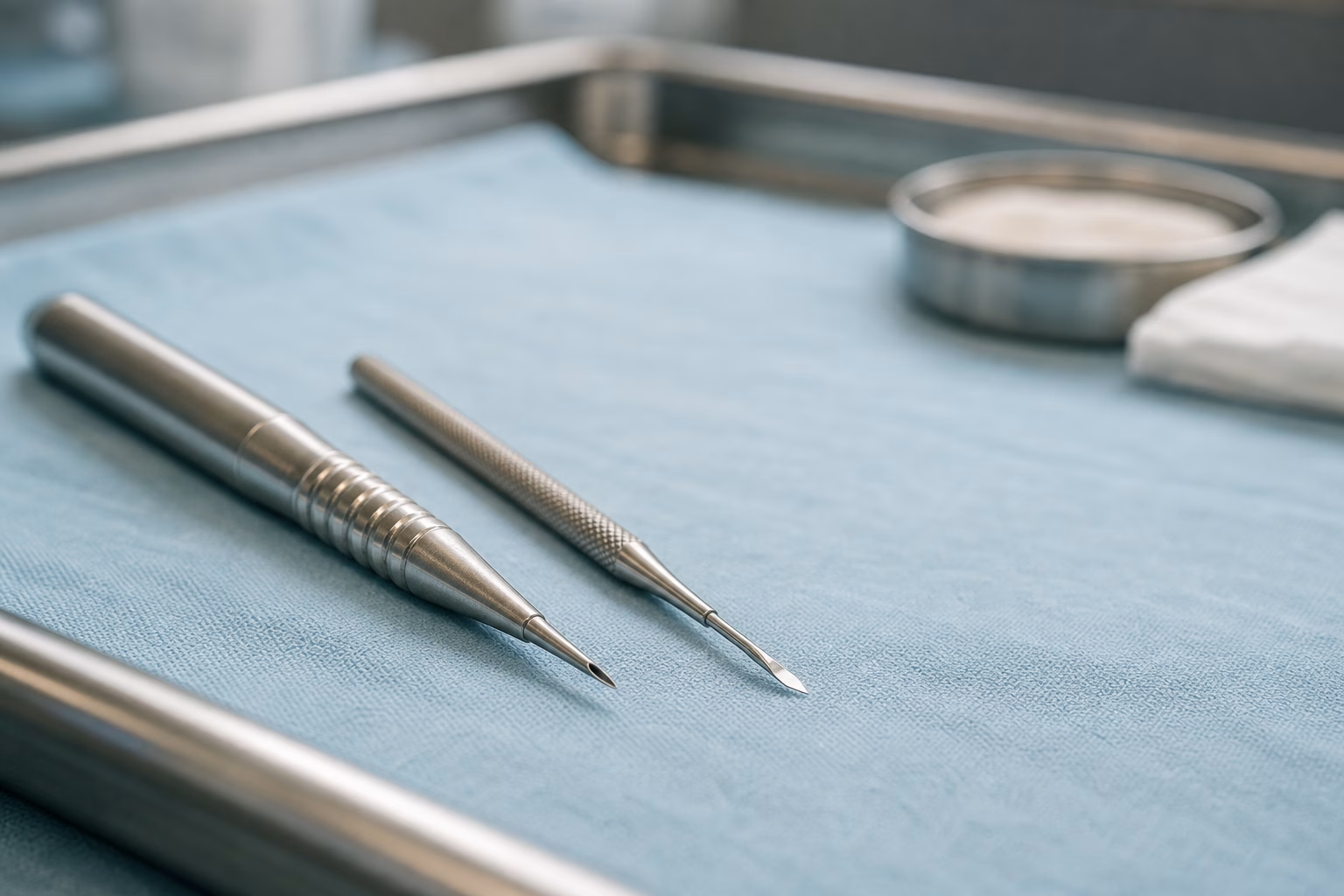
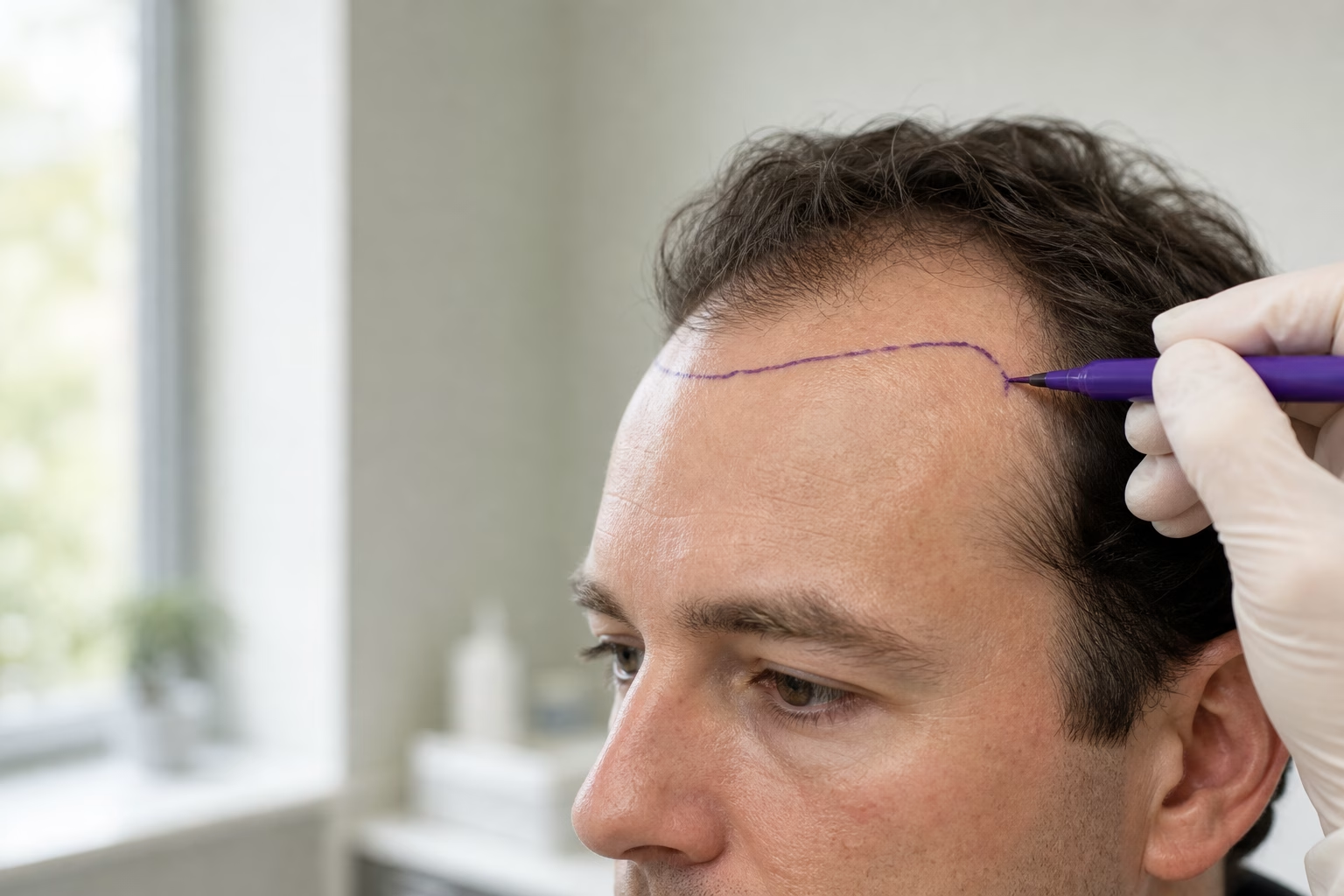
DHI and Sapphire FUE are not alternatives to FUE. They are variations of follicular unit extraction (FUE). In all three, individual follicular units are harvested one by one from the donor area, usually the back and sides of the scalp, with a small micro-punch, and no linear strip of skin is removed. The techniques differ at implantation. In Sapphire FUE, recipient sites are opened with sapphire blades and grafts are then placed into them. In DHI (Direct Hair Implantation), grafts are loaded into an implanter pen that places each one while controlling its angle and direction.
None of the three is objectively best. The right choice depends on your donor capacity, hair loss pattern, hair characteristics and goals. That decision is made at an in-person consultation with a licensed provider, not by technique name alone.
Step by Step: Extraction Is Shared, Implantation Is Where They Split
Every FUE-based transplant has two stages. The first looks essentially the same whichever technique you choose. The second is where classic FUE, Sapphire FUE and DHI part ways.
Stage 1: Extraction (the same in all three)
- The procedure is done under local anesthesia.
- Individual follicular units are harvested one by one with a micro-punch, typically from the back or sides of the scalp.
- The donor area is left with small, dot-like wounds instead of a single linear incision. Because no strip of skin is removed, there is no linear scar, which leaves more freedom to wear short hairstyles.
Stage 2: Implantation (where they differ)
- Classic FUE: the team creates recipient sites in the thinning area, then places the grafts into them.
- Sapphire FUE: the same sequence, but the recipient sites are opened with fine sapphire blades instead of steel instruments, when clinically appropriate.
- DHI: each graft is loaded into an implanter pen, which places it while the team controls its angle and direction.
Why the implantation step matters
The implantation method affects how grafts are handled, how the team sequences the work, and how much direct control there is over the angle and direction of each hair. These are factors your team weighs when planning your case. On their own, they are not proof that one technique produces better growth, density or healing, so be cautious of any clinic that presents them that way.
Side-by-Side Comparison: Shaving, Placement, Area Size, and Recovery
| Factor |
Classic FUE |
Sapphire FUE |
DHI |
| Extraction |
Micro-punch, one unit at a time |
Same as classic FUE |
Same as classic FUE |
| Implantation |
Recipient sites created first, then grafts placed |
Recipient sites created with sapphire blades, then grafts placed |
Each graft placed with an implanter pen |
| Shaving |
Extent of shaving agreed case by case |
Extent of shaving agreed case by case |
No-shave or limited-shave approaches may suit selected patients |
| Placement detail |
Depends on the team’s planning and skill |
Precise recipient-site creation when clinically appropriate |
Detailed control over the angle and direction of each graft |
| Large areas (crown, full scalp) |
Planned individually; larger cases can be split into two procedures on different days |
All three are done under local anesthesia. Treatment typically takes 4 to 8 hours, depending mainly on the size of the case, and recovery guidance is the same for FUE and DHI patients.
A note on the evidence
You will often see bold superiority claims online for both DHI and Sapphire FUE. In practice, results depend heavily on the team, the quality of your donor area, careful planning and aftercare. If a clinic tells you one technique gives more density or faster healing, it is fair to ask what evidence supports that for a case like yours.
Who Might Fit Which Technique (and Who Might Not Need Surgery Yet)
The technique follows the plan, not the other way around. Your hair loss pattern, donor capacity, hair characteristics and goals point toward an approach.
Common scenarios
- Refining a receding hairline or temples. When the angle and direction of each hair matter a great deal, DHI’s placement control is often part of the discussion. Sapphire FUE may also be considered when clinically appropriate.
- A woman with thinning at the part line who does not want to shave. DHI No-Shave may be considered, so existing hair stays in place during recovery. See our page on female hair transplant and DHI No-Shave.
- A large crown or full-scalp area. Bigger areas are planned individually and may be split into two procedures on different days.
- Beard or eyebrows. These are planned individually, based on eligibility.
When surgery may not be the right first step
If hair loss is active, unstable or not yet diagnosed, a transplant may not be the best place to start. Some types of hair loss respond better to non-surgical care, and a responsible team should tell you honestly if a transplant is not the right first step. Confirming the cause of thinning before surgery is particularly worth asking about if you are a woman with diffuse or part-line thinning.
Questions to ask at your consultation
- Is my donor area stable and sufficient for the area I want treated?
- Which technique do you suggest for my pattern, and why?
- Will I need to shave fully, partly or not at all?
- How will you design my hairline for my face and age?
- Would my case need staged sessions?
- How do you plan for hair loss that may continue in the future?
Recovery and Results Timeline: What Is Similar Across All Three
Recovery depends more on the extraction and the size of the session than on the technique’s name, and the early steps look much the same.
- First 10 days: grafts need protection from friction, pressure and tight headwear.
- Back to routine: timing varies. Many patients need about 2 to 3 days of downtime. Ask what to expect for your session size.
- Shedding: transplanted hairs often shed in the first weeks before new growth starts.
- Growth: new hair appears gradually over the following months, and the final result is usually assessed at about a year.
Hair moved from the donor area is generally considered more resistant to pattern hair loss, but your existing native hair may continue to thin, which is why long-term planning matters. Like any surgical procedure, a transplant carries risks, so ask your provider to explain the possible side effects for your case. For a more detailed timeline, see our guide to hair transplant recovery day by day.
Cost and Planning: Why Technique Name Is Not the Whole Price Story
You may see transplant quotes based on graft count. AestheteMed prices by package, based on the area you want treated, and the package covers the FUE or DHI procedure. Optional add-ons are priced separately.
- Small area: $6,000
- Regular area: $7,000
- Large area: $8,000
Packages are not tied to a fixed graft count. The goal is to cover the agreed treatment area based on your donor supply. Up to 5,000 grafts can be transplanted in one session when it is clinically possible and safe, and larger cases can be planned in stages on different days. Financing is available, with terms discussed at your consultation. Your final plan and price are confirmed in person. For more on pricing, see our hair transplant cost guide for Miami.
How AestheteMed in Hallandale Beach Approaches Technique Choice
AestheteMed is located at 2100 East Hallandale Beach Boulevard #100, Hallandale Beach, FL 33009, and serves patients from Miami, Aventura and Fort Lauderdale. Procedures are performed by Gianna Oliveira together with an experienced hair transplant team, under the medical supervision of Dr. Paul Goldberg.
The team works with a modern Turkish technique using Sapphire FUE and DHI. The method is selected after evaluating your hair loss pattern, donor capacity, hair characteristics and desired result. Every plan starts with an individual hairline design built around your face, and women can choose DHI No-Shave when it suits their case. Learn more about the FUE hair transplant procedure and our personalized hair restoration approach.
If you are weighing DHI against FUE or Sapphire FUE, book a consultation. Bring the questions above, and the team will assess your donor area and tell you which approach, if any, fits your goals.
Frequently asked questions
Is DHI better than FUE?
DHI is a type of FUE. Extraction is essentially the same; the difference is how grafts are implanted. Neither is objectively best. Suitability depends on your donor area, hair loss pattern and goals, and is decided at an in-person consultation with a licensed provider.
Do I have to shave my head for DHI or Sapphire FUE?
Not always. No-shave or limited-shave options may suit selected patients, and DHI No-Shave is offered for women. How much shaving you need depends on the area being treated and is confirmed at your consultation.
Which technique gives more density?
Density depends mainly on your donor supply, the plan and the skill of the team rather than the technique name. Be cautious of claims that one method always delivers more density, and ask what supports that claim for a case like yours.
Can women get a DHI hair transplant?
Women with thinning at the part line, temples or hairline and a stable donor area may be candidates. The cause of the hair loss should be assessed first, because some types respond better to non-surgical care.
How long until I see results?
Transplanted hairs often shed in the first weeks. New growth appears gradually over the following months, and the final result is usually assessed at about a year.
Does Sapphire FUE leave scars?
FUE, including Sapphire FUE and DHI, avoids a linear scar because no strip of skin is removed. The donor area is left with small dot-like wounds instead. How visible they are later varies, so ask your provider about your donor area.
Sources