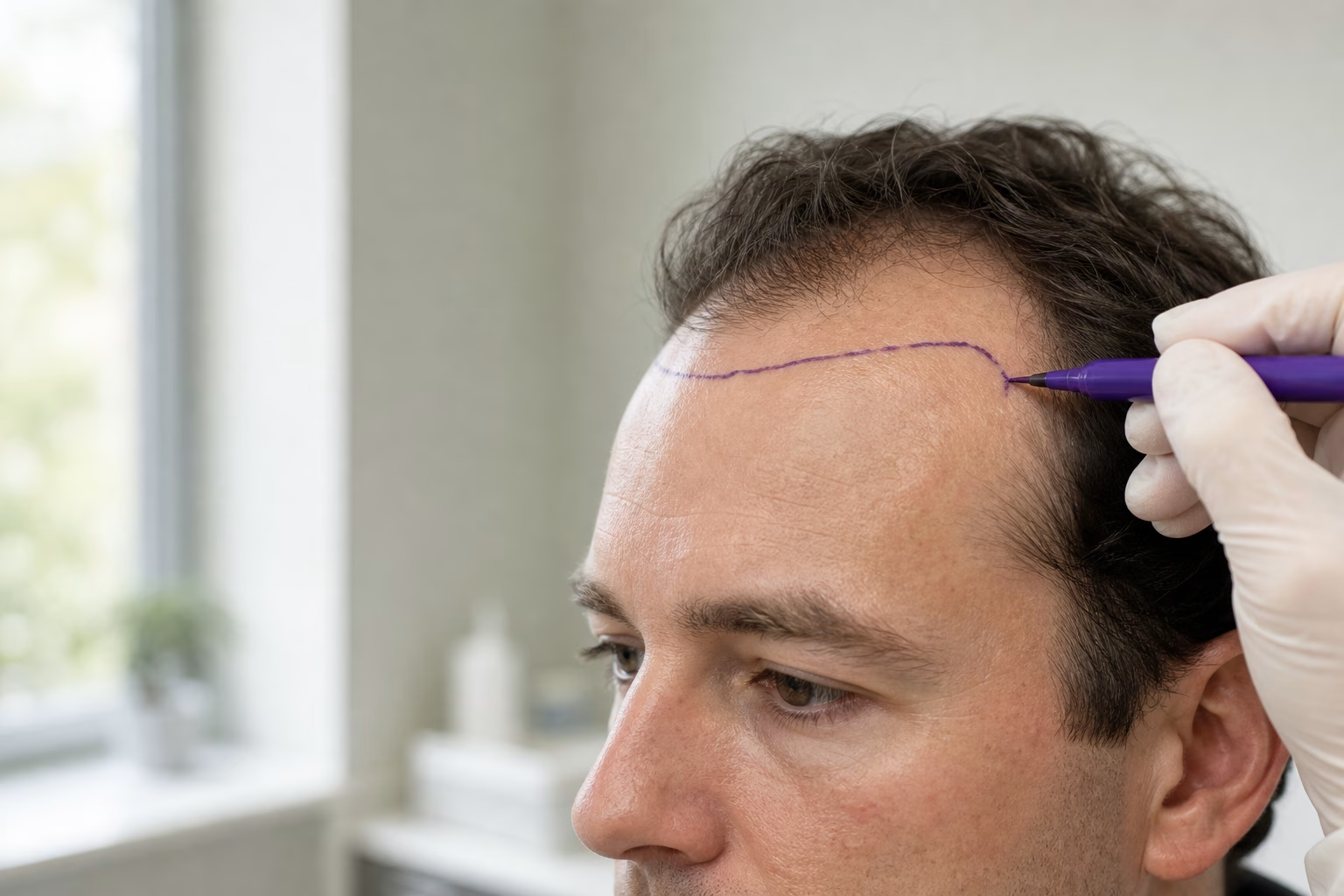
“Ozempic face” is an informal, media-popularized term, not a medical diagnosis. It describes a hollowed, deflated, or older-looking face that some people notice after significant or rapid weight loss while taking GLP-1 medications such as semaglutide (Ozempic, Wegovy) or tirzepatide (Mounjaro, Zepbound). The change is generally attributed to losing facial fat along with body fat, not to a direct effect of the drug on facial tissue, and similar changes can follow weight loss by other means. Not everyone who takes these medications notices it.
Options to address it include hyaluronic acid fillers, biostimulators, RF microneedling, and skin boosters, but each targets a different problem. This guide explains why the changes happen, what to discuss with your prescriber, and how to match each option to what you actually see in the mirror. Research that looks specifically at GLP-1-related facial changes is still limited.
What Is Ozempic Face?
The nickname borrows the brand name of one widely known GLP-1 medication. It describes how a face looks, not a recognized medical condition. People who use the term usually mean some combination of these changes:
- Hollow cheeks and sunken temples
- Deeper nasolabial folds (smile lines) and marionette lines
- A softer, less defined jawline, sometimes with loose skin under the chin
- Hollowness under the eyes
- Thinner, drier, or crepey skin texture
Similar changes can follow weight loss from diet, exercise, illness, or surgery. The medication matters mainly because it can make substantial weight loss happen faster. If you notice these changes, mention them to your prescriber.
Why Does Weight Loss Change the Face?
The face has its own fat, and when you lose body fat, you lose some of it from your face too. If your skin cannot contract enough to match the smaller volume underneath, it may fold or sag.
Three overlapping problems
- Lost volume. Fat in the cheeks, temples, and under the eyes gives the face its rounded contours. When it shrinks, those areas can look flat or hollow.
- Lost structural support. With less volume underneath, the mid-face and jawline have less to hold the skin up, so folds can deepen and the lower face can look heavier.
- Reduced skin quality. Skin that has lost elasticity, often because of age, sun exposure, or genetics, does not bounce back as easily. It may look thinner, duller, or crepey.
Each problem points to a different kind of treatment. A filler adds volume but does not tighten loose skin, and a skin-tightening treatment does not replace lost volume.
Why speed and age may matter
Fast or large weight loss gives the skin less time to adapt, and older skin generally has less elasticity to work with. That may help explain why some people notice changes more than others. There is no established threshold for how much or how fast weight loss leads to visible facial changes, so be cautious of anyone who quotes exact numbers.
Can You Prevent or Slow Ozempic Face?
There is no proven way to prevent facial volume loss while losing weight. The habits below support overall health and body composition and are worth discussing with the clinician who prescribes your medication.
- Keep weight loss supervised and steady. The pace of weight loss on a GLP-1 medication is shaped by dosing, and dosing is your prescriber’s decision. Never stop or adjust your medication on your own because of appearance concerns.
- Prioritize protein. Adequate protein during calorie reduction is often advised to help preserve lean mass. The right amount is individual, so ask your clinician or a registered dietitian.
- Add resistance training. Strength training is often advised to help maintain muscle while losing weight. Start at a level that is safe for you.
- Protect your skin from the sun. Daily sun protection supports long-term skin quality.
- Eat well overall and stay hydrated. A reduced appetite can make balanced nutrition harder to achieve.
There is little direct evidence that these steps prevent facial volume loss specifically. If you are considering weight-loss medication, you can read about the clinic’s GLP-1 injections program.
Ozempic Face Treatment Options Matched to Your Concern
Because lost volume, lost support, and reduced skin quality often overlap, a plan may combine options over several visits, for example volume restoration followed by a skin-quality treatment. The right mix, product, and amount are decided at an in-person consultation with a licensed provider. The table gives a general overview of each option; individual results vary.
| Main concern |
Option |
How it works |
What to expect |
| Localized hollows in cheeks, temples, or folds |
Hyaluronic acid fillers |
Adds volume where it is placed |
Product and amount chosen at consultation |
| Broader volume loss and weaker support |
Biostimulators (Sculptra, Radiesse) |
Stimulates your own collagen over time |
Gradual (Sculptra) or immediate plus gradual (Radiesse) |
| Undefined jawline or chin, deep folds |
Radiesse |
CaHA gel for structure plus collagen stimulation |
Immediate support that the clinic says improves as collagen builds |
| Loose skin, wrinkles, rough texture |
Morpheus8 |
Microneedling plus radiofrequency heat |
Gradual remodeling; does not add volume |
| Dull, dehydrated, crepey skin |
Skin boosters |
Micro-injections of fluid hyaluronic acid |
Skin quality focus; does not change contours |
Hyaluronic acid fillers for localized hollows
Hyaluronic acid (HA) fillers are what most people mean by “fillers.” Hyaluronic acid is a substance found naturally in the skin that binds water, and HA fillers add volume where they are placed. They are often considered for targeted areas such as hollow cheeks, temples, and deep folds. Placement depends on your anatomy, and you can ask at consultation which HA products are used. More details are on the clinic’s filler treatment page.
Biostimulators for broader volume loss
Biostimulators prompt your body to build its own collagen instead of only filling space. According to the clinic’s biostimulator treatments page, Sculptra results appear gradually over 3 to 6 months as collagen builds, while Radiesse provides instant volume, with collagen stimulation improving skin elasticity over time. Biostimulators may be worth discussing if your volume loss is spread across the face rather than limited to one spot.
Radiesse: immediate support plus collagen stimulation
The clinic describes Radiesse as calcium hydroxylapatite (CaHA) microspheres in a water-based gel. The gel gives immediate volume, and the microspheres act as a scaffold that stimulates new collagen and elastin. The clinic calls it a firm filler and uses it for jawline and chin contouring, cheek volume, nasolabial folds, and marionette lines. It also offers a hyperdiluted protocol it describes for neck skin laxity.
The clinic lists Radiesse as FDA approved. FDA approvals cover specific uses, so ask your provider which approved indication applies to the area you want treated.
Morpheus8 for loose skin and texture
According to the clinic, Morpheus8 combines microneedling with radiofrequency energy: the microneedles create controlled micro-injuries while RF energy heats deeper tissue to stimulate collagen and elastin production. The clinic uses it for mild to moderate skin laxity, wrinkles, and uneven texture on the face, jawline, and neck. It does not replace lost volume, so it is usually discussed alongside fillers or biostimulators rather than instead of them.
Skin boosters for dull, crepey skin
The clinic describes skin boosters as micro-injections of a thin hyaluronic acid gel that spread through the skin layers to improve hydration and texture. They are meant to improve skin quality, not to restore contours or volume. The clinic generally recommends an initial series of 2 to 3 sessions spaced about 4 weeks apart. Ask which product is used and whether it is FDA approved for the area being treated.
Timing, Risks, and Realistic Expectations
When to start treatment
Some providers prefer to plan major volume restoration once weight is relatively stable, because further loss can change how results look. Treat this as a consideration to discuss, not a fixed rule. If you are still losing weight, a provider may suggest waiting, starting with a smaller plan, or focusing on skin quality first. The decision belongs to you and your provider together.
Typical downtime
- Radiesse: the clinic notes treatment takes 15 to 30 minutes and the product is often mixed with lidocaine for comfort. Slight swelling or bruising is possible afterward.
- Morpheus8: numbing cream is applied first. Temporary redness, swelling, or mild bruising usually fades within a few days.
- Skin boosters: small raised bumps (micro-papules) appear at the injection sites, with downtime the clinic lists as 1 to 2 days.
Serious risks
These are minimally invasive procedures, not risk-free ones. Injectable fillers carry uncommon but serious risks, including accidental injection into a blood vessel, which can cause tissue damage, vision problems including blindness, or stroke. Choose a licensed provider who reviews your health history. For selected injectables, the clinic may use handheld ultrasound to view tissue layers, vessels, blood flow, and existing filler. Ultrasound adds information but does not eliminate procedural risk or replace clinical judgment.
What results can and cannot do
Results vary from person to person. They are not permanent, and maintenance treatments are usually needed. A realistic goal is a face that looks rested and supported, not a different face.
How AestheteMed Can Help in South Florida
AestheteMed Beauty & Wellness Clinic is located at 2100 East Hallandale Beach Boulevard #100, Hallandale Beach, FL 33009, and serves patients from Miami, Aventura, and Fort Lauderdale.
Care starts with a consultation. Your provider assesses your facial structure, volume loss, skin quality, and where you are in your weight-loss journey, then recommends a plan. That plan may include hyaluronic acid fillers, biostimulators such as Radiesse, Morpheus8, skin boosters, or no treatment yet.
The clinic also offers GLP-1 injections, so GLP-1 care and aesthetic care are available at the same location. Pricing is confirmed at your consultation.
Frequently asked questions
Does Ozempic face go away if I stop the medication?
Not reliably. The changes come from fat loss, so stopping the medication does not by itself restore facial volume. Weight regain after stopping is a separate medical issue to discuss with your prescriber, and you should not stop or change your medication without their guidance.
Does tirzepatide (Mounjaro or Zepbound) cause the same thing?
Similar facial changes can happen with significant weight loss from any cause, including tirzepatide, other GLP-1 medications, diet, or surgery. The term “Ozempic face” simply uses the most widely known brand name.
Can I get fillers or Radiesse while still taking semaglutide?
That decision is made by your provider after reviewing your health history, current medications, and weight-loss stage. Tell both your prescriber and your injector about every medication and treatment so they can plan safely.
How long do results last?
It depends on the product, the area, and the person. Radiesse results typically last about a year, sometimes longer, depending on the person and treated area. According to the FDA, the effects of hyaluronic acid fillers usually last about 6 to 12 months. Ask your provider what to expect from Morpheus8 or skin boosters.
Sources