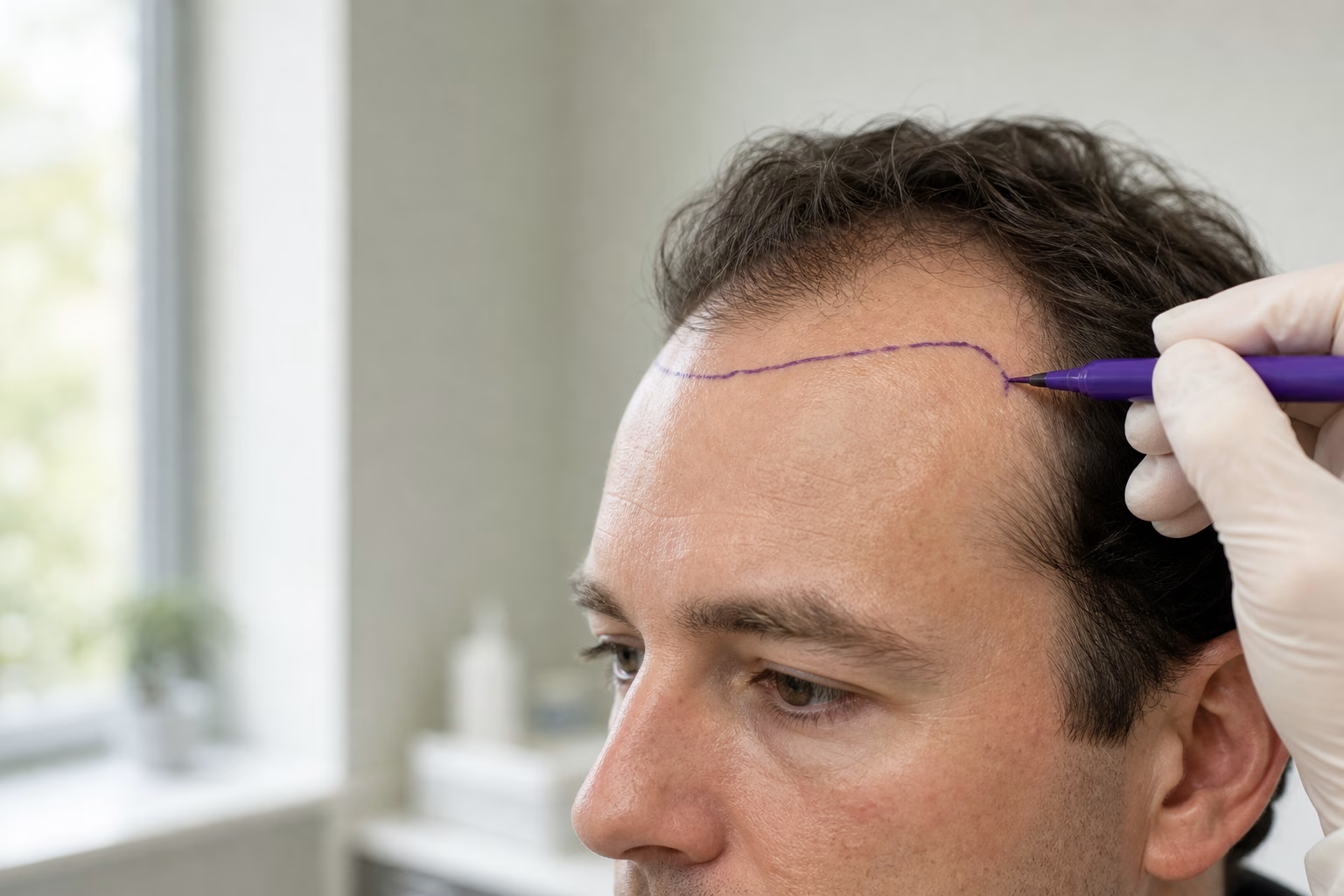
A receding hairline is a frontal hairline that keeps moving back over time, usually most at the temples, so the front takes on an M shape. In men it is most often an early sign of androgenetic alopecia, also called male pattern hair loss. Not every change is a problem, though: many hairlines rise slightly between the late teens and the twenties and then hold steady. That is a mature hairline, and it usually needs nothing more than monitoring.
The difference shapes what you do next. A receding hairline tends to progress, so it is worth having it assessed rather than waiting, especially before you choose between medication, supportive treatments and a hair transplant. This guide covers a self-check, the Norwood scale, common causes and how treatments compare by strength of evidence.
Mature Hairline vs. Receding Hairline: How to Tell the Difference
A mature hairline settles a little higher than your teenage hairline and then stays stable, with an even shape and normal-thickness hairs at the edge. A receding hairline keeps moving back year after year, and the hairs along the front edge often become finer and shorter.
That thinning of individual hairs is called miniaturization. It is one of the most useful clues, because a hairline that simply sits higher still has strong hairs along its border.
Early signs of a receding hairline
- Temple corners that deepen, creating a more pronounced M shape
- Fine, wispy hairs along the front edge where hair used to be thicker
- More scalp showing through the front when your hair is wet
- A hairline that looks uneven from one side to the other
- Noticeably more shedding than usual
A simple at-home check
Compare photos taken a year or more apart, ideally with your hair pulled back and in similar lighting. If the temples are moving back faster than the center, or the border keeps shifting, that pattern points toward recession rather than maturation. A family history of pattern hair loss adds to the picture.
Photos are a starting point, not a diagnosis. A provider can examine the scalp up close to look for miniaturization directly.
When to see a dermatologist first
Some signs suggest something other than typical pattern loss. See a board-certified dermatologist if you notice:
- An itchy, burning or scaly scalp
- Redness along the hairline
- Sudden or patchy hair loss
- Thinning or loss of the eyebrows
These signs can point to other conditions, including inflammatory or scarring ones, that need their own diagnosis and treatment plan.
Norwood Stages Explained: Where Is Your Hairline Now?
The Norwood scale, also called the Hamilton-Norwood scale, is widely used to classify male pattern hair loss. It runs in seven stages, from no recession to extensive loss across the top and crown, and helps you and your provider describe the pattern and track it over time.
| Stage |
What it typically looks like |
Options commonly discussed |
| 1 |
No meaningful recession |
Monitoring |
| 2 |
Slight temple recession, often consistent with a mature hairline |
Monitoring with photos over time |
| 3 and 3 vertex |
First clearly visible recession at the temples; the vertex variant adds thinning at the crown |
Medical therapy; consultation if it is progressing |
| 4 to 5 |
Deeper frontal recession and crown thinning; the band of hair between the two areas narrows and thins by stage 5 |
Medical therapy; a transplant may be considered if loss is stable and donor hair allows |
| 6 to 7 |
Front and crown merge; hair remains mainly at the back and sides |
Planning is limited by donor supply; priorities are set with your provider |
The table describes general patterns, not a treatment plan. A licensed provider should confirm your stage in person, because lighting, hairstyle and hair texture can make a hairline look better or worse than it is.
Hairline changes in women
Women with pattern hair loss usually keep their frontal hairline and instead notice diffuse thinning and a widening part, which clinicians grade on different scales such as Ludwig or Sinclair. Because frontal recession is less typical in women, it is worth having a dermatologist evaluate it to rule out traction or a scarring condition.
What Causes a Receding Hairline?
The most common cause is androgenetic alopecia, a hereditary form of hair loss. Traction from tight hairstyles is another cause, and a few less common conditions can look similar at first.
Androgenetic alopecia
In androgenetic alopecia, hair follicles in genetically susceptible areas are sensitive to dihydrotestosterone (DHT), a hormone derived from testosterone. Over time, affected follicles shrink and produce shorter, finer hairs, and some eventually stop producing visible hair. In men this typically begins at the temples, the crown, or both.
Traction alopecia
Traction alopecia comes from repeated pulling on the hair from tight braids, ponytails, buns, extensions or snug headwear. It often affects the front and sides of the hairline. Easing the tension early can allow hair to recover, while long-term tension may lead to lasting loss.
Conditions that can look similar
- Frontal fibrosing alopecia: a scarring condition that gradually moves the hairline back, seen more often in women and frequently involving the eyebrows.
- Telogen effluvium: widespread shedding that can follow illness, major stress, childbirth or rapid weight loss, usually diffuse rather than limited to the hairline.
- Alopecia areata: an autoimmune condition that typically causes smooth, round patches of hair loss.
The practical takeaway: get a diagnosis before any transplant or cosmetic treatment. Scarring and active inflammatory conditions are managed very differently from pattern hair loss.
Medical Treatments: Minoxidil and Finasteride
For androgenetic alopecia, medication is generally the first step: topical minoxidil and, for men, finasteride prescribed by a physician. The realistic goal is to slow further loss and help miniaturized hairs; medication alone is less likely to fully restore a deep temple recession.
Minoxidil
Topical minoxidil is sold over the counter in the United States for pattern hair loss. It needs consistent use for several months before you can judge the effect, and some people notice temporary extra shedding when they start. It tends to work better for maintenance and on the crown than for regrowing receded temples, and gains are generally lost if you stop.
Low-dose oral minoxidil is sometimes used off-label for hair loss. That is a decision for a physician who has reviewed your health history, not something to start on your own.
Finasteride
Finasteride is a prescription medication FDA-approved for male pattern hair loss in men, and it works by lowering DHT. Its labeling notes that its effect on recession at the temples has not been established, so it is mainly used to slow further loss. It must be prescribed and monitored by a physician, who will review your medical history and the possible side effects listed in the product labeling, including sexual and mood-related effects. It is not approved for women, and women who are or may become pregnant should not take it or handle crushed or broken tablets.
Why medication still matters if you plan a transplant
A transplant moves follicles, but it does not stop your existing hair from continuing to thin. Without a plan to protect native hair, the area behind a new hairline can keep receding and leave a visible gap. For that reason, many transplant candidates continue medical therapy as agreed with their physician.
PRP and Exosomes: Supportive Options, Not Replacements
PRP and exosome treatments are in-office options that some people add to their plan. The evidence is still developing, so they are best viewed as supportive treatments alongside medical therapy or after a transplant, not as a stand-alone fix for a receded hairline.
PRP for hair
Platelet-rich plasma (PRP) is prepared by drawing a small amount of your blood, concentrating the platelets, and injecting the plasma into thinning areas of the scalp over a series of sessions. Studies suggest it may help some people with androgenetic alopecia, but protocols are not standardized and the quality of evidence varies. You can read how our clinic offers PRP therapy for hair.
Exosomes for hair
Exosomes are tiny vesicles that cells use to carry signaling molecules, and exosome products are being explored as an emerging hair treatment. Human clinical data are limited, and no exosome product is FDA-approved to treat hair loss. If you are considering this option, ask your provider about the specific product, its regulatory status and what outcomes are realistic. The protocol used at our clinic is described on the BENEV exosomes for hair page.
Neither PRP nor exosomes can rebuild a hairline where follicles are already gone. Pricing for both is confirmed at consultation.
When Does FUE or DHI Hairline Restoration Make Sense?
A hair transplant makes the most sense when the diagnosis is confirmed as non-scarring pattern loss, the loss has been relatively stable, and there is enough healthy donor hair at the back and sides of the scalp. Your expectations about density also need to match what that donor supply can provide.
Signs you may be a good candidate
- A confirmed diagnosis, such as androgenetic alopecia, with no active scarring or inflammation
- Loss that has slowed or stabilized, often with ongoing medical therapy
- Adequate donor density at the back and sides of the scalp
- Realistic goals about how dense and how low the new hairline can be
Younger patients deserve extra caution. When the long-term pattern is not yet clear, a very low hairline can look out of place years later as surrounding hair continues to recede.
FUE vs. DHI
In FUE (follicular unit extraction), individual follicular units are taken one by one from the donor area with a precision micro-punch. No strip of skin is removed, so there is no linear scar, although small dot-like marks remain where follicles were extracted. In DHI, the harvested grafts are placed with an implanter pen. Neither method is automatically better; the choice depends on your case and should be discussed with your provider.
Why hairline design matters
The hairline is the most visible part of any transplant, and its design has a large effect on how natural the result looks. A natural hairline is not a straight line: it has small irregularities, soft temple points and a gradual transition from single hairs to fuller density. Good design places single-hair grafts at the leading edge and denser grafts behind them, and sets the height and shape to suit your face and age.
At our clinic, the new hairline is drawn and agreed with you before anything else, as described on our hairline lowering and hairline design page. The same approach can lower a naturally high forehead in men and women, which is a separate goal from treating recession.
How many grafts you need depends on the area to cover and your donor supply. Our guide on how many grafts you may need covers this in more detail.
What recovery generally looks like
Your provider will give you aftercare instructions for your case, typically including protecting the grafts from friction, pressure and tight headwear in the early days. Transplanted hairs often shed in the first weeks before new growth starts. Growth then comes in gradually, and the final result of a new hairline is usually assessed at around a year.
How AestheteMed Approaches Hairline Restoration in Hallandale Beach
AestheteMed Beauty & Wellness Clinic is located at 2100 East Hallandale Beach Boulevard #100, Hallandale Beach, FL 33009, and serves patients from Miami, Aventura and Fort Lauderdale. Hair restoration procedures are performed by Gianna Oliveira together with an experienced hair transplant team, under the medical supervision of Dr. Paul Goldberg.
- Technique: a modern Turkish technique using Sapphire FUE and DHI
- Hairline design: every plan starts with an individual hairline built around your face, your hair loss pattern and your donor area
- Session size: up to 5,000 grafts in one session when clinically possible and safe; larger cases are planned in stages on different days
- Options for women: DHI No-Shave, based on individual candidacy
Packages are priced by the area treated: Small $6,000, Regular $7,000 and Large $8,000. Packages are not tied to a fixed graft count; they cover the agreed area based on your donor supply. Financing is available, and terms are discussed at consultation.
Whether a transplant, medical therapy, a supportive treatment or simply monitoring is right for you is decided at an in-person consultation with a licensed provider. You can learn more about the procedure on our FUE hair transplant page before your visit.
Frequently asked questions
Can a receding hairline grow back on its own?
In pattern hair loss, follicles that have stopped producing visible hair generally do not recover without treatment, and recession tends to progress. Traction alopecia is different: if the tension from tight styles is removed early, hair may recover. A provider can tell you which one you are dealing with.
Is it normal for my hairline to move back in my 20s?
A small, even rise that then stays stable is common and is usually a mature hairline. If the temples keep deepening, edge hairs look finer, or photos show ongoing change, have it evaluated, ideally by a dermatologist.
Does minoxidil work on a receding hairline?
It may help some people, but results at the temples are less predictable than on the crown, and it only works while you keep using it. Ask a physician whether it fits your situation.
Can women get a hairline transplant?
Yes, when the diagnosis and donor supply allow. Frontal recession in women should be evaluated first to rule out traction or scarring conditions. At AestheteMed, options for women include DHI No-Shave.
How many grafts does a hairline need, and what does it cost?
It depends on the area to cover and your donor supply, so there is no single number. Our grafts guide explains the factors in more detail. At AestheteMed, packages start at $6,000 for a Small area, and the right package and final price are confirmed at consultation.
Sources