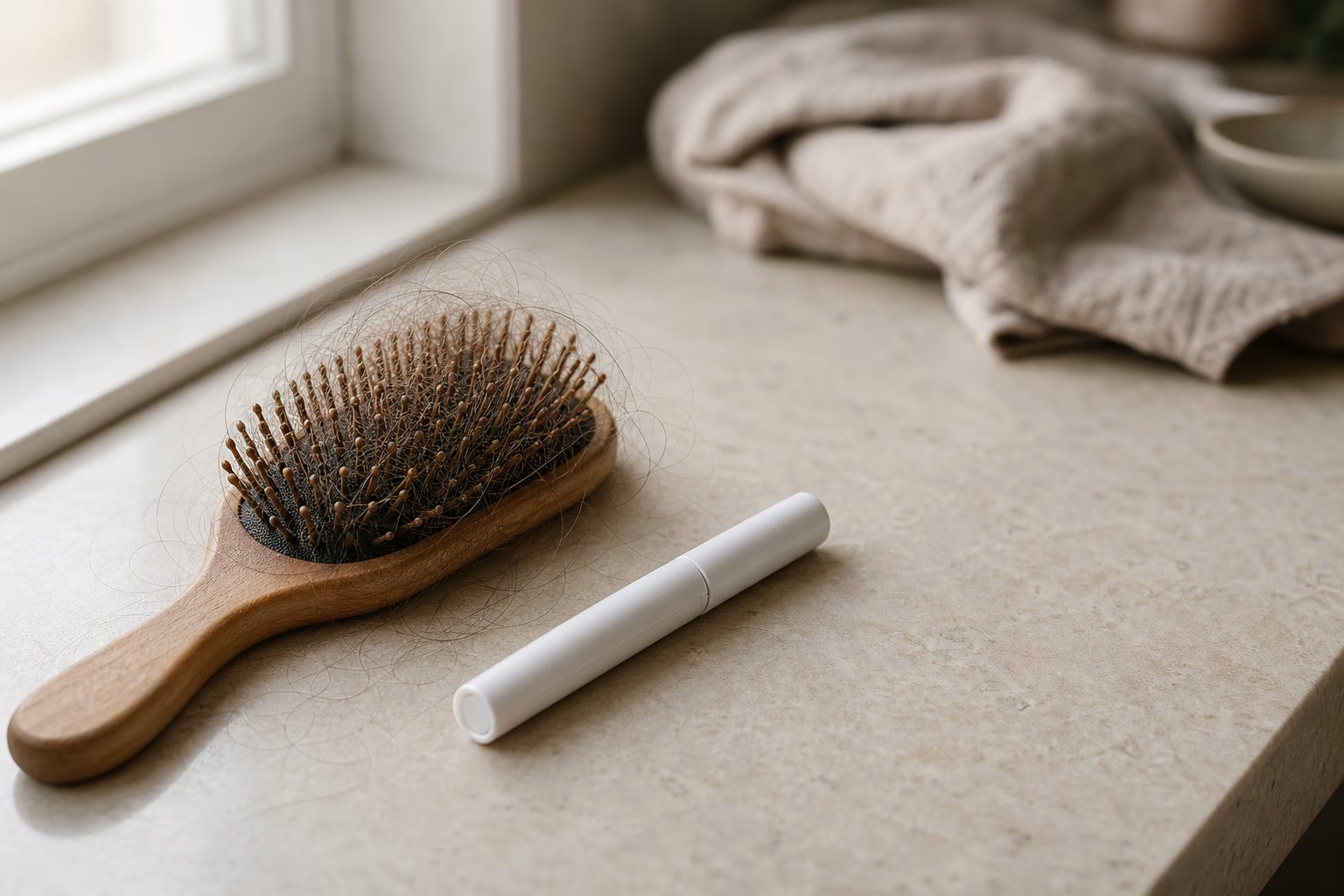
Ozempic Hair Loss: The Short Answer
Some people do notice extra shedding on Ozempic, but the leading explanation is the rapid weight loss, not a direct effect of semaglutide on hair follicles. A direct effect has not been established. The pattern most often described is telogen effluvium, a temporary shedding phase that can follow fast weight loss, a steep calorie deficit, or low protein intake. In most people it settles once weight stabilizes and nutrition is adequate, although visible regrowth takes months. Do not stop or change your dose on your own; talk to your prescriber first.
Ozempic and Wegovy contain the same active ingredient, semaglutide, but at different doses and for different uses: Ozempic for type 2 diabetes, Wegovy for weight management. Most of the label data on hair loss comes from the weight management labels, so it should not be applied one to one to Ozempic.
This article is general education, not a diagnosis. It walks through how to check the timing, what the labels say, which nutrients and lab tests to discuss, and how to tell shedding apart from genetic pattern loss.
Why Rapid Weight Loss Triggers Shedding: Telogen Effluvium Explained
Each hair follicle cycles through a growing phase (anagen), a short transition phase, and a resting phase (telogen). Normally most of your hair is growing at any given time. A significant physical stressor, such as fast weight loss, a sharp drop in calories, major illness, or surgery, can push a larger share of follicles into the resting phase at once. Those hairs usually fall out a few months later, which is why the shedding often seems to come out of nowhere.
What the Shedding Looks Like
- Diffuse thinning across the whole scalp rather than bald patches
- More hair than usual in the brush, on the pillow, or in the shower drain
- A ponytail that feels thinner
- Shed hairs that often have a small white bulb at the root
A Simple Timing Self-Check
- Write down when you started the medication and each dose increase.
- Mark the weeks or months when your weight dropped fastest.
- Note when the shedding began.
If the shedding started a few months after your fastest weight loss, telogen effluvium is a reasonable explanation to raise with your provider. If the timing does not line up, that is a reason to look for other causes.
What the Drug Labels Report
The FDA prescribing information for Wegovy (semaglutide for weight management) and Zepbound (tirzepatide) lists alopecia, the medical term for hair loss, among adverse reactions reported more often with the medication than with placebo in clinical trials. In weight-management trials, hair loss was reported in about 3% of people taking Wegovy 2.4 mg compared with 1% on placebo, and it was more common in women (4%) than in men (0.9%). For Zepbound, the figure was 4% to 5% compared with 1% on placebo, again mostly in women (7.1% versus 0.5% of men). Both labels note that hair loss was associated with weight reduction. The Ozempic and Mounjaro labels list alopecia among reports received after approval, where the frequency cannot be reliably estimated.
Hair shedding is also reported after bariatric surgery and other rapid weight loss. That supports the weight loss explanation, but it is an association, not a proven mechanism.
Protein, Calories and Nutrients: What to Look At First
Why Appetite Changes Matter for Hair
GLP-1 medications reduce appetite, so many people eat far less protein and fewer calories without noticing. Hair is made mostly of keratin, a protein, and when meals shrink, protein is often the first thing to slip. Ask your prescriber or a registered dietitian for a protein target that fits your body size, kidney health, and goals, especially during the fastest weight loss phase.
The nutrients and markers most often reviewed when someone is shedding are:
- Iron stores, measured as ferritin
- Zinc
- Vitamin D
- Vitamin B12
- Thyroid function
Supplements: More Is Not Better
High-dose hair supplements are not a shortcut. Excess intake of some nutrients, including vitamin A and selenium, is itself linked to hair loss. High-dose biotin is another caution because the FDA has warned it can interfere with certain lab tests. Tell your provider about every supplement you take before a blood draw.
Which Lab Tests to Ask About
Blood work helps separate weight loss shedding from deficiencies, thyroid problems, or other conditions. Your provider chooses the final panel, but these are reasonable tests to bring up:
- CBC (complete blood count)
- Comprehensive metabolic panel (CMP)
- Thyroid markers: TSH, T3, and T4
- Ferritin
- Vitamin D
- Zinc
- Vitamin B12
A standard weight loss panel may not cover all of these. For example, the Weight Loss Blood Work panel listed by AestheteMed includes CBC, CMP, TSH, T3, T4, A1c, and a lipid panel. Ferritin, vitamin D, zinc, and B12 are not listed in that base panel, so if shedding is your concern, ask whether an extended or customized panel suits you. The clinic notes that a customized blood test can be arranged and that a Medical Doctor or Nurse Practitioner reviews results in a lab review consultation. Pricing is confirmed at consultation.
Temporary Shedding or Pattern Hair Loss? How to Tell the Difference
The next step depends on which one you have.
| Feature |
Telogen effluvium (shedding) |
Androgenetic alopecia (pattern loss) |
| Onset |
Fairly sudden, often after a trigger such as rapid weight loss |
Gradual over years |
| Where |
Diffuse, across the whole scalp |
Receding hairline or thinning crown in men; widening part in women |
| Hair |
Normal-thickness hairs shed, often with a white bulb |
Hairs become progressively finer (miniaturized) |
| Course |
Usually improves over months once the trigger settles |
Tends to progress over time |
The two can overlap. Weight loss shedding can make an existing genetic tendency more visible, so some people notice their part or crown for the first time while on a GLP-1 medication.
Red Flags That Need Prompt Evaluation
- Round or patchy bald spots
- Scalp pain, burning, redness, or scaling
- Loss of eyebrows, eyelashes, or body hair
- Shedding that continues well beyond several months or keeps getting worse
If you notice any of these, see a licensed provider or a board-certified dermatologist rather than waiting it out.
What You Can Do While Shedding Settles
Hairs that have already entered the resting phase will still fall out, so some shedding continues for a while. The aim is to address ongoing triggers and give regrowth time.
- Review the pace of weight loss with your prescriber, including the timing of dose increases.
- Make protein a priority at every meal, and ask a dietitian how to reach your target with a smaller appetite.
- Check labs before supplementing, and correct true deficiencies under supervision.
- Be gentle with your hair: avoid tight styles and limit harsh chemical treatments while shedding is active.
- Track progress with photos of your part and hairline in the same light every few weeks, since regrowth is slow and easy to miss.
How AestheteMed in Hallandale Beach Can Help
AestheteMed is a med spa and wellness clinic at 2100 E Hallandale Beach Blvd, serving patients from Miami, Aventura, and Fort Lauderdale. Suitability for any treatment is decided at an in-person consultation.
Your Weight Loss Plan and Lab Work
If you are using or considering medical weight loss, the clinic’s GLP-1 injection program runs under medical supervision, so the pace of weight loss and your nutrition can be discussed with a provider along the way. If shedding is a concern, ask about lab testing before or during treatment.
Supportive Scalp Treatments
Telogen effluvium usually resolves on its own once the trigger settles, so scalp treatments are optional support, not a requirement. Published research on PRP therapy for hair focuses mainly on pattern hair loss rather than shedding. Evidence for exosome treatments for hair is still early, and no exosome product is FDA approved to treat hair loss. A provider can explain whether either option fits your situation; pricing is confirmed at consultation.
When a Hair Transplant Makes Sense
A transplant is not a treatment for shedding. Hair lost to telogen effluvium is expected to regrow, so moving follicles does not address the cause. An FUE hair transplant is considered for stable genetic pattern loss, after shedding has settled and donor supply has been assessed.
At AestheteMed, procedures are performed by Gianna Oliveira together with an experienced hair transplant team, under the medical supervision of Dr. Paul Goldberg. The team uses a modern Turkish technique with Sapphire FUE and DHI, and each plan starts with an individual hairline design. Up to 5,000 grafts can be placed in one procedure when clinically possible and safe; larger cases can be planned in stages on different days. DHI No-Shave is an option for women. Packages are Small ($6,000), Regular ($7,000), and Large ($8,000). They are based on the agreed treatment area rather than a fixed graft count. Financing is available, with terms discussed at consultation.
Frequently asked questions
Will my hair grow back after Ozempic shedding?
In most cases of telogen effluvium, yes, because the follicles are resting rather than destroyed. Regrowth is gradual and can take several months to become visible. If it does not improve, or you see patchy loss or a thinning crown or part, ask a licensed provider to evaluate you.
How long does hair shedding on GLP-1 medications last?
Telogen effluvium typically slows over several months once the trigger, such as rapid weight loss, settles and nutrition is adequate. Visible recovery takes longer because hair grows slowly. Shedding that continues well beyond that window deserves a medical evaluation.
Should I stop Ozempic if my hair is falling out?
Not on your own. Shedding is usually linked to the pace of weight loss and nutrition, which can often be addressed while you stay on treatment. Ask your prescriber to review your dose schedule, protein intake, and labs.
Do Mounjaro or Zepbound cause hair loss too?
Both contain tirzepatide. The Zepbound prescribing information reports hair loss in 4% to 5% of trial participants compared with 1% on placebo, more often in women, and links it to weight reduction. The Mounjaro label lists alopecia among reports received after approval.
Can PRP or a hair transplant fix Ozempic hair loss?
PRP may be discussed as an optional supportive treatment, though research focuses mainly on pattern hair loss. A transplant does not treat shedding; it is considered only for stable genetic pattern loss once shedding has settled. Suitability is decided at an in-person consultation.
Sources