Top Benefits of FUE Hair Transplant: The Gold Standard in Follicular Unit Extraction

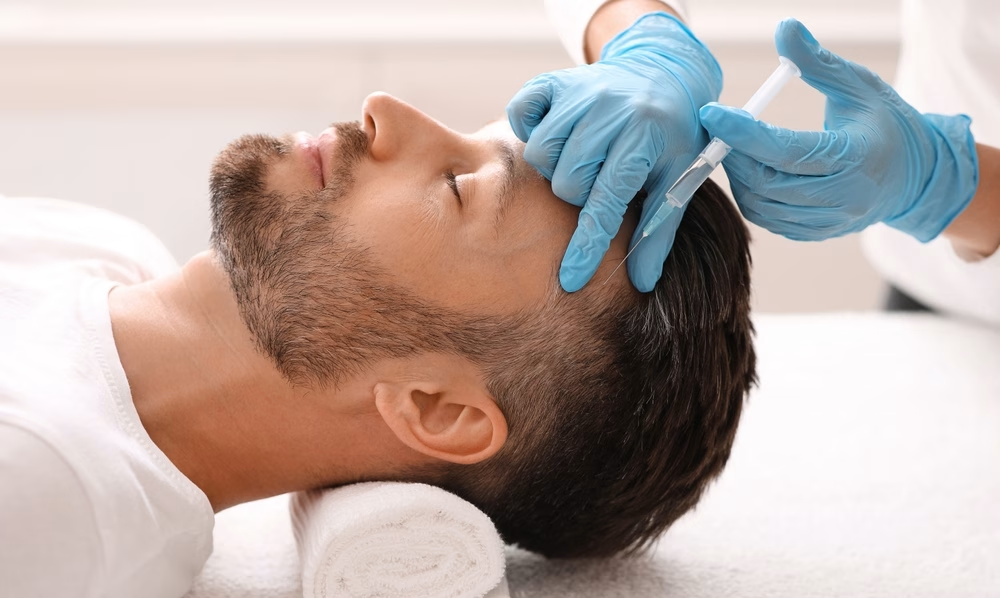
Mesotherapy Hair Treatment | Aesthetemed Beauty & Wellness Clinic

Discover how advanced FUE (Follicular Unit Extraction) technology uses precision micro-punches to harvest individual hair follicles — without linear scars, staples, or lengthy recovery periods. Learn the science, expected results, and real benefits of this revolutionary hair restoration method.


What Is FUE Hair Transplant?

FUE (Follicular Unit Extraction) is a cutting-edge, minimally invasive hair restoration technique that involves harvesting individual hair follicular units directly from the donor area (typically the back and sides of the scalp) using a specialized micro-punch tool with a diameter of 0.7–1.0 mm. Unlike traditional FUT (Follicular Unit Transplantation) — which removes a strip of tissue and leaves a linear scar — FUE extracts follicles one by one, preserving the natural architecture of the donor zone.

The procedure is performed under local anesthesia. Each follicle is carefully extracted and immediately transplanted into thinning or balding areas (hairline, crown, or temples) with meticulous attention to natural angle, direction, and density. A typical session lasts between 4 to 8 hours, depending on the number of grafts required — usually ranging from 1,500 to 4,000+ grafts per session.

How Does It Work?

During treatment, the surgeon uses a precision motorized or manual punch to gently extract intact follicular units. These grafts are then meticulously implanted into recipient sites created with ultra-fine needles or blades. The process triggers a cascade of natural healing and growth responses:

  • Immediate graft placement — follicles are transplanted into precisely angled recipient incisions
  • Stimulation of dormant follicles — neighboring hair follicles may be reactivated by the healing process
  • Improved blood supply to thinning areas — enhanced circulation supports new growth
  • Natural hair cycle progression — transplanted hair sheds within 2–4 weeks, followed by new permanent growth starting at 3–4 months
  • Full maturation — final density and thickness develop over 12–18 months

Key Benefits & Expected Results

1. No Linear Scar — Perfect for Short Hair

FUE leaves hundreds of tiny, dot-like scars (less than 1 mm in diameter) that are virtually invisible, even with a shaved head or very short buzz cut. This makes FUE the preferred choice for patients who want the freedom to wear their hair any length without worrying about a telltale strip scar.

Clinical surveys show that over 95% of patients prioritize scarless results when choosing between FUE and FUT, with FUE consistently rated as the more aesthetically appealing option.

2. Faster Recovery with Minimal Discomfort

Because FUE does not involve incisions, stitches, or tension on the scalp, recovery is significantly faster. Most patients return to work and normal activities within 3–5 days. Any redness, tiny scabs, or mild swelling typically resolve within 7–10 days, and the donor area heals completely within 2 weeks.

3. Higher Graft Survival Rate

With advanced FUE techniques (especially when using magnification and hydration solutions), graft survival rates consistently exceed 90–95%. The atraumatic extraction process preserves the delicate follicular stem cells, ensuring robust growth in the recipient area.

4. Natural-Looking Results

FUE allows surgeons to hand-pick the finest, softest single-hair follicles for the frontal hairline, creating a completely natural, soft transition. Multi-hair units are placed behind the hairline for density, mimicking nature’s own distribution pattern. Over 92% of patients report being “very satisfied” or “extremely satisfied” with the natural appearance of their results.

5. Less Post-Operative Pain and Swelling

With no large incisions or tissue stretching, FUE patients experience significantly less post-operative pain, swelling, and numbness compared to FUT. Most manage any mild discomfort with over-the-counter pain relievers for just 1–2 days.

6. Suitable for All Hair Types and Genders

FUE is highly versatile and effective for all hair textures — straight, wavy, curly, or afro — across all skin types. It is equally successful for both men (male pattern baldness) and women (diffuse thinning, traction alopecia, or cosmetic enhancement).


What Does the Science Say?

The effectiveness of FUE is grounded in well-documented trichological principles:

  • Follicular Unit Integrity: Extracting intact follicular units preserves the dermal papilla, bulge region (stem cell niche), and surrounding extracellular matrix, all critical for viable regrowth.
  • Angiogenesis: The recipient site incision triggers localized neovascularization, bringing oxygen and nutrients to support the transplanted follicle.
  • Wound Healing Cascade: Controlled micro-wounds in both donor and recipient areas stimulate growth factors (VEGF, FGF, TGF-β) that promote tissue repair and hair cycle reactivation.

Peer-reviewed studies indicate a graft survival rate of 90–98% in modern FUE procedures, with visible growth reported in 98% of transplanted follicles within 12 months post-surgery.


FUE vs. FUT (Strip) Hair Transplant

Feature FUE Hair Transplant FUT (Strip) Hair Transplant
Invasiveness Minimally invasive Invasive surgical strip removal
Scarring 1,000+ tiny dot scars (undetectable) Single linear scar (typically 15–25 cm)
Anesthesia Local anesthesia only Local + possible sedation
Primary Goal Natural density with individual follicle placement Maximum grafts from a single strip
Downtime 3–5 days (mild redness, tiny scabs) 2–3 weeks (sutures, tension, swelling, numbness)
Risk Profile Very low (minimal risk of complications) Higher (infection, widened scar, nerve damage, tissue stretching)
Haircut Flexibility Full freedom — any length, including shaved Limited — scar visible with short hair
Graft Yield per Session 1,500–4,500+ grafts 2,000–6,000+ grafts

Treatment Timeline: Before, During, and After

Session Experience

Prior to your session, a thorough scalp assessment and hairline design consultation is conducted. Local anesthesia is applied to both donor and recipient areas, ensuring a completely pain-free experience.

  • Duration: 4–8 hours (depending on graft count)
  • Sensation: Mild pressure but no sharp pain
  • Anesthesia: Local (fully awake, comfortable)
  • Downtime: 3–5 days (tiny scabs, mild redness)

Results & Growth Schedule

Phase Timeline Expected Outcome
Immediate Post-Op Days 1–10 Small scabs, mild pinkness; donor area heals
Shock Loss / Shedding Weeks 2–6 Transplanted hairs fall out (normal and expected)
Early Growth Phase Months 3–5 Fine, soft new hairs begin emerging
Significant Growth Months 6–9 Noticeable thickening and coverage improvement
Peak Maturation Months 12–18 Full density, texture, and natural styling achieved

Who Is an Ideal Candidate?

You may be an excellent candidate for an FUE hair transplant if you:

  • Have male or female pattern baldness (Norwood scale II–VI or Ludwig scale I–III)
  • Experience thinning of the hairline, crown, or temples
  • Suffer from traction alopecia, scarring alopecia, or previous transplant failures
  • Desire facial hair restoration (beard, mustache, eyebrows)
  • Want to restore density after a FUT scar revision or repair surgery
  • Prefer a scarless procedure with minimal downtime
  • Have sufficient donor hair density (evaluated via trichoscopy)

Important Note: While FUE delivers outstanding results, candidates with advanced diffuse thinning (poor donor supply), active autoimmune alopecia, or unstable hair loss patterns may need medical stabilization first. Your surgeon will perform a detailed scalp analysis during consultation to set realistic expectations.


Frequently Asked Questions

Is FUE hair transplant painful?
Patient comfort is a priority. The procedure is performed under local anesthesia, so you’ll feel only mild pressure or vibration during extraction and implantation. Post-operative discomfort is typically mild and manageable with OTC pain relief for 1–2 days.

How many grafts will I need?
This depends on your degree of hair loss and your goals. On average:

  • Hairline restoration: 1,200–2,000 grafts
  • Moderate crown thinning: 1,500–2,500 grafts
  • Extensive balding: 3,000–4,500+ grafts

When will I see the final results?
Hair growth follows its natural cycle. You’ll see initial “peach fuzz” at 3–4 months, significant improvement at 6–9 months, and the final, full result at 12–18 months after the procedure.

Can FUE be combined with other treatments?
Absolutely! FUE pairs exceptionally well with:

  • PRP (Platelet-Rich Plasma) therapy — accelerates healing and boosts growth
  • Low-Level Laser Therapy (LLLT) — stimulates mitochondria in follicles
  • Oral or topical finasteride/minoxidil — maintains existing hair and prevents further loss

What is the recovery like?
Recovery is remarkably fast. You can resume desk work in 3–5 days. Tiny scabs fall off naturally within 7–10 days. Strenuous exercise should be avoided for 2–3 weeks, but normal daily activities resume almost immediately.

Will the transplanted hair fall out again?
No. The follicles harvested from the donor area are genetically resistant to DHT (dihydrotestosterone) — the hormone responsible for pattern baldness. This means the transplanted hair is permanent and will continue to grow naturally for a lifetime.


Why Choose FUE Hair Transplant?

FUE offers a unique combination of safety, aesthetics, and convenience that distinguishes it from other hair restoration options:

  • FDA-Cleared Technology — globally recognized and clinically validated
  • No Linear Scar — wear your hair any way you like
  • Proven Clinical Results — 95%+ patient satisfaction rates
  • Minimal Downtime — back to work in just days
  • Permanent Solution — one procedure, lifetime results
  • Natural Hairline Design — artistic, age-appropriate, and personalized
  • Safe for All Skin & Hair Types — inclusive and effective

Related Treatments for Comprehensive Hair Restoration

Explore other advanced treatments that complement FUE for optimal hair health and aesthetics:

  • PRP Therapy — Platelet-rich plasma injections to accelerate graft survival and stimulate dormant follicles
  • Low-Level Laser Therapy (LLLT) — Red light therapy caps to boost circulation and cellular energy
  • Mesotherapy — Nutrient and vitamin injections for scalp rejuvenation
  • Scalp Micropigmentation (SMP) — Creates the illusion of density for thinning areas
  • Medical Therapy — Finasteride, dutasteride, or minoxidil to preserve existing hair

Schedule Your FUE Consultation Today

Ready to restore your hair, confidence, and youthful appearance? Schedule your personalized consultation today to discover how FUE hair transplant can give you natural, permanent, life-changing results.

Book your FUE consultation today — your journey to renewed hair and confidence starts here.


Disclaimer: Results may vary depending on individual factors including age, hair type, degree of hair loss, and overall health. Always consult with a qualified, board-certified hair restoration surgeon to determine if FUE is right for you.

Join our newsletter

Footer Subscription Form

By submitting this form, you agree to receive emails about our products, sales, exclusive content and more. View our Privacy Policy.

© 2025 AestheteMed. All rights reserved. 

Book Now

Book Now

Call us (786) 966-7878 or Chat with us on WhatsApp  for more information!

Top Benefits of FUE Hair Transplant: The Gold Standard in Follicular Unit Extraction

Top Benefits of FUE Hair Transplant: The Gold Standard in Follicular Unit Extraction

Discover how advanced FUE (Follicular Unit Extraction) technology uses precision micro-punches to harvest individual hair follicles — without linear scars, staples, or lengthy recovery periods. Learn the science, expected results, and real benefits of this revolutionary hair restoration method.


What Is FUE Hair Transplant?

FUE (Follicular Unit Extraction) is a cutting-edge, minimally invasive hair restoration technique that involves harvesting individual hair follicular units directly from the donor area (typically the back and sides of the scalp) using a specialized micro-punch tool with a diameter of 0.7–1.0 mm. Unlike traditional FUT (Follicular Unit Transplantation) — which removes a strip of tissue and leaves a linear scar — FUE extracts follicles one by one, preserving the natural architecture of the donor zone.

The procedure is performed under local anesthesia. Each follicle is carefully extracted and immediately transplanted into thinning or balding areas (hairline, crown, or temples) with meticulous attention to natural angle, direction, and density. A typical session lasts between 4 to 8 hours, depending on the number of grafts required — usually ranging from 1,500 to 4,000+ grafts per session.

How Does It Work?

During treatment, the surgeon uses a precision motorized or manual punch to gently extract intact follicular units. These grafts are then meticulously implanted into recipient sites created with ultra-fine needles or blades. The process triggers a cascade of natural healing and growth responses:

  • Immediate graft placement — follicles are transplanted into precisely angled recipient incisions
  • Stimulation of dormant follicles — neighboring hair follicles may be reactivated by the healing process
  • Improved blood supply to thinning areas — enhanced circulation supports new growth
  • Natural hair cycle progression — transplanted hair sheds within 2–4 weeks, followed by new permanent growth starting at 3–4 months
  • Full maturation — final density and thickness develop over 12–18 months

Key Benefits & Expected Results

1. No Linear Scar — Perfect for Short Hair

FUE leaves hundreds of tiny, dot-like scars (less than 1 mm in diameter) that are virtually invisible, even with a shaved head or very short buzz cut. This makes FUE the preferred choice for patients who want the freedom to wear their hair any length without worrying about a telltale strip scar.

Clinical surveys show that over 95% of patients prioritize scarless results when choosing between FUE and FUT, with FUE consistently rated as the more aesthetically appealing option.

2. Faster Recovery with Minimal Discomfort

Because FUE does not involve incisions, stitches, or tension on the scalp, recovery is significantly faster. Most patients return to work and normal activities within 3–5 days. Any redness, tiny scabs, or mild swelling typically resolve within 7–10 days, and the donor area heals completely within 2 weeks.

3. Higher Graft Survival Rate

With advanced FUE techniques (especially when using magnification and hydration solutions), graft survival rates consistently exceed 90–95%. The atraumatic extraction process preserves the delicate follicular stem cells, ensuring robust growth in the recipient area.

4. Natural-Looking Results

FUE allows surgeons to hand-pick the finest, softest single-hair follicles for the frontal hairline, creating a completely natural, soft transition. Multi-hair units are placed behind the hairline for density, mimicking nature’s own distribution pattern. Over 92% of patients report being “very satisfied” or “extremely satisfied” with the natural appearance of their results.

5. Less Post-Operative Pain and Swelling

With no large incisions or tissue stretching, FUE patients experience significantly less post-operative pain, swelling, and numbness compared to FUT. Most manage any mild discomfort with over-the-counter pain relievers for just 1–2 days.

6. Suitable for All Hair Types and Genders

FUE is highly versatile and effective for all hair textures — straight, wavy, curly, or afro — across all skin types. It is equally successful for both men (male pattern baldness) and women (diffuse thinning, traction alopecia, or cosmetic enhancement).


What Does the Science Say?

The effectiveness of FUE is grounded in well-documented trichological principles:

  • Follicular Unit Integrity: Extracting intact follicular units preserves the dermal papilla, bulge region (stem cell niche), and surrounding extracellular matrix, all critical for viable regrowth.
  • Angiogenesis: The recipient site incision triggers localized neovascularization, bringing oxygen and nutrients to support the transplanted follicle.
  • Wound Healing Cascade: Controlled micro-wounds in both donor and recipient areas stimulate growth factors (VEGF, FGF, TGF-β) that promote tissue repair and hair cycle reactivation.

Peer-reviewed studies indicate a graft survival rate of 90–98% in modern FUE procedures, with visible growth reported in 98% of transplanted follicles within 12 months post-surgery.


FUE vs. FUT (Strip) Hair Transplant

Feature FUE Hair Transplant FUT (Strip) Hair Transplant
Invasiveness Minimally invasive Invasive surgical strip removal
Scarring 1,000+ tiny dot scars (undetectable) Single linear scar (typically 15–25 cm)
Anesthesia Local anesthesia only Local + possible sedation
Primary Goal Natural density with individual follicle placement Maximum grafts from a single strip
Downtime 3–5 days (mild redness, tiny scabs) 2–3 weeks (sutures, tension, swelling, numbness)
Risk Profile Very low (minimal risk of complications) Higher (infection, widened scar, nerve damage, tissue stretching)
Haircut Flexibility Full freedom — any length, including shaved Limited — scar visible with short hair
Graft Yield per Session 1,500–4,500+ grafts 2,000–6,000+ grafts

Treatment Timeline: Before, During, and After

Session Experience

Prior to your session, a thorough scalp assessment and hairline design consultation is conducted. Local anesthesia is applied to both donor and recipient areas, ensuring a completely pain-free experience.

  • Duration: 4–8 hours (depending on graft count)
  • Sensation: Mild pressure but no sharp pain
  • Anesthesia: Local (fully awake, comfortable)
  • Downtime: 3–5 days (tiny scabs, mild redness)

Results & Growth Schedule

Phase Timeline Expected Outcome
Immediate Post-Op Days 1–10 Small scabs, mild pinkness; donor area heals
Shock Loss / Shedding Weeks 2–6 Transplanted hairs fall out (normal and expected)
Early Growth Phase Months 3–5 Fine, soft new hairs begin emerging
Significant Growth Months 6–9 Noticeable thickening and coverage improvement
Peak Maturation Months 12–18 Full density, texture, and natural styling achieved

Who Is an Ideal Candidate?

You may be an excellent candidate for an FUE hair transplant if you:

  • Have male or female pattern baldness (Norwood scale II–VI or Ludwig scale I–III)
  • Experience thinning of the hairline, crown, or temples
  • Suffer from traction alopecia, scarring alopecia, or previous transplant failures
  • Desire facial hair restoration (beard, mustache, eyebrows)
  • Want to restore density after a FUT scar revision or repair surgery
  • Prefer a scarless procedure with minimal downtime
  • Have sufficient donor hair density (evaluated via trichoscopy)

Important Note: While FUE delivers outstanding results, candidates with advanced diffuse thinning (poor donor supply), active autoimmune alopecia, or unstable hair loss patterns may need medical stabilization first. Your surgeon will perform a detailed scalp analysis during consultation to set realistic expectations.


Frequently Asked Questions

Is FUE hair transplant painful?
Patient comfort is a priority. The procedure is performed under local anesthesia, so you’ll feel only mild pressure or vibration during extraction and implantation. Post-operative discomfort is typically mild and manageable with OTC pain relief for 1–2 days.

How many grafts will I need?
This depends on your degree of hair loss and your goals. On average:

  • Hairline restoration: 1,200–2,000 grafts
  • Moderate crown thinning: 1,500–2,500 grafts
  • Extensive balding: 3,000–4,500+ grafts

When will I see the final results?
Hair growth follows its natural cycle. You’ll see initial “peach fuzz” at 3–4 months, significant improvement at 6–9 months, and the final, full result at 12–18 months after the procedure.

Can FUE be combined with other treatments?
Absolutely! FUE pairs exceptionally well with:

  • PRP (Platelet-Rich Plasma) therapy — accelerates healing and boosts growth
  • Low-Level Laser Therapy (LLLT) — stimulates mitochondria in follicles
  • Oral or topical finasteride/minoxidil — maintains existing hair and prevents further loss

What is the recovery like?
Recovery is remarkably fast. You can resume desk work in 3–5 days. Tiny scabs fall off naturally within 7–10 days. Strenuous exercise should be avoided for 2–3 weeks, but normal daily activities resume almost immediately.

Will the transplanted hair fall out again?
No. The follicles harvested from the donor area are genetically resistant to DHT (dihydrotestosterone) — the hormone responsible for pattern baldness. This means the transplanted hair is permanent and will continue to grow naturally for a lifetime.


Why Choose FUE Hair Transplant?

FUE offers a unique combination of safety, aesthetics, and convenience that distinguishes it from other hair restoration options:

  • FDA-Cleared Technology — globally recognized and clinically validated
  • No Linear Scar — wear your hair any way you like
  • Proven Clinical Results — 95%+ patient satisfaction rates
  • Minimal Downtime — back to work in just days
  • Permanent Solution — one procedure, lifetime results
  • Natural Hairline Design — artistic, age-appropriate, and personalized
  • Safe for All Skin & Hair Types — inclusive and effective

Related Treatments for Comprehensive Hair Restoration

Explore other advanced treatments that complement FUE for optimal hair health and aesthetics:

  • PRP Therapy — Platelet-rich plasma injections to accelerate graft survival and stimulate dormant follicles
  • Low-Level Laser Therapy (LLLT) — Red light therapy caps to boost circulation and cellular energy
  • Mesotherapy — Nutrient and vitamin injections for scalp rejuvenation
  • Scalp Micropigmentation (SMP) — Creates the illusion of density for thinning areas
  • Medical Therapy — Finasteride, dutasteride, or minoxidil to preserve existing hair

Schedule Your FUE Consultation Today

Ready to restore your hair, confidence, and youthful appearance? Schedule your personalized consultation today to discover how FUE hair transplant can give you natural, permanent, life-changing results.

Book your FUE consultation today — your journey to renewed hair and confidence starts here.


Disclaimer: Results may vary depending on individual factors including age, hair type, degree of hair loss, and overall health. Always consult with a qualified, board-certified hair restoration surgeon to determine if FUE is right for you.

Contact Us

Call us (786) 966-7878 or Chat with us on WhatsApp  for more information!

Name(Required)