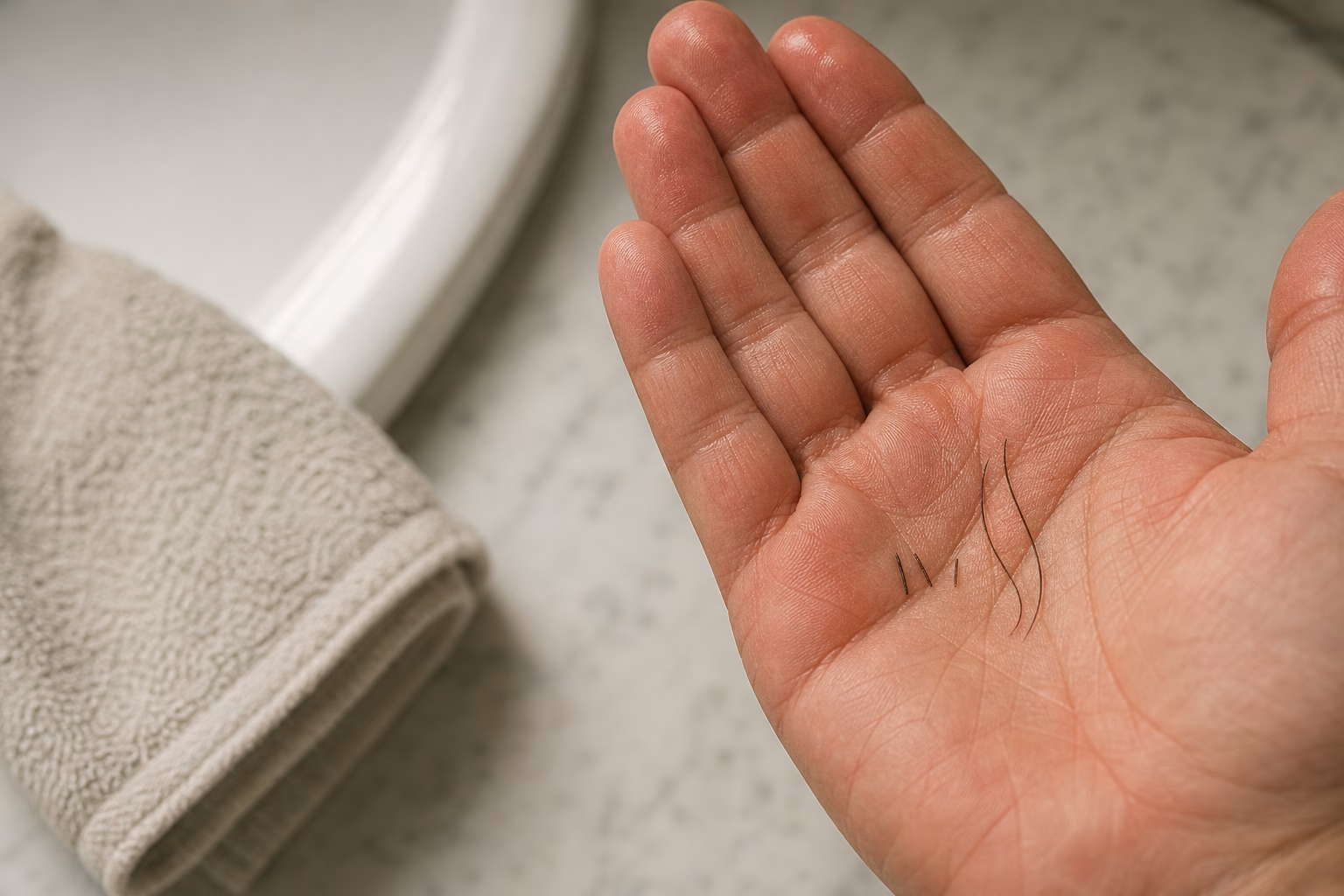
Hair Transplant Shock Loss: The Short Answer
Hair transplant shock loss is temporary shedding of your existing, non-transplanted hair in or near the surgical area after a hair transplant. It is commonly attributed to surgical trauma and is usually described as temporary, although hairs already weakened by pattern hair loss may not fully return. It is a different event from the expected shedding of the transplanted graft hairs in the first weeks after surgery.
The practical question is simple: which hairs are you losing, where, and when? The answer helps you decide whether to wait or to call your clinic.
Three Kinds of Hair Loss After Surgery
Patients often call anything that falls out after surgery shock loss. It is more useful to separate three events:
- Transplanted graft shedding. The short implanted hair shafts fall out, while the follicle under the skin typically stays in place and later produces new hair.
- Recipient-area shock loss. Native hairs that were already growing between or around the new grafts shed temporarily.
- Donor-area shock loss. Hair in the harvesting zone, usually the back or sides of the scalp, thins temporarily around the extraction sites.
Graft Shedding vs. Shock Loss: How to Tell Which One You Have
Start by asking whether the falling hairs are the short transplanted hairs or your own longer hairs that were there before surgery. Location and timing usually narrow it down.
| Feature |
Graft shedding |
Shock loss |
| Which hairs |
Transplanted hair shafts |
Pre-existing native hairs |
| Where |
Inside the grafted zone |
Between or around grafts, or in the donor zone |
| Typical timing |
Commonly around weeks 2 to 6 |
Often within the first weeks to about two months |
| Appearance |
Short shafts, sometimes with tiny crust remnants attached |
Thinning of longer hair; the area can look sparser than before surgery |
| Expected course |
New growth from the retained follicle over the following months |
Usually temporary; already miniaturized hairs may not fully return |
A Quick Self-Check
- Were these hairs on your head before surgery?
- Are they noticeably longer than the transplanted hairs?
- Is the thinning outside the exact area where grafts were placed?
If you answer yes to most of these, the pattern fits shock loss better than graft shedding. Short hairs coming from the grafted zone in the first several weeks fit normal graft shedding. If you cannot tell, ask your provider to check at a follow-up visit. For what the scalp typically looks like during healing, see our guide to hair transplant recovery day by day.
Why Does Shock Loss Happen?
Shock loss is usually explained as a reaction of nearby follicles to surgical stress, which pushes them into a resting phase before they regrow. The exact mechanism is not fully established, so treat the points below as commonly proposed explanations rather than proven causes.
- Physical trauma. Incisions and implantation channels are made close to existing follicles, and some follicles react to the disturbance.
- Inflammation and swelling. The healing response may temporarily affect the environment around native hairs.
- Temporary changes in blood supply. Local circulation may be briefly disrupted during and after the procedure.
- A shift into the resting phase. Stressed follicles may enter the resting (telogen) stage of the hair cycle early and release their shafts, similar to stress-related shedding (telogen effluvium).
Be cautious of any claim that a particular technique, including Sapphire FUE or DHI, makes shock loss impossible. Careful planning and gentle handling are part of good surgical practice, but they are not a guarantee.
When Does Hair Grow Back After Shock Loss? A Cautious Timeline
Hair lost to shock loss typically returns over a period of months as follicles move from rest back into growth. Timelines vary from person to person, so use these ranges as orientation, not a promise.
- First days: most patients return to their normal routine in 2 to 3 days, and scabbing usually resolves within about a week.
- Weeks 2 to 6: Transplanted graft shafts commonly shed.
- First weeks to about two months: Shock loss of native hair, if it occurs, often becomes noticeable.
- Around 3 to 4 months: Early regrowth often begins, both in the transplanted hair and in native hair lost to shock loss.
- Later months: New hair continues to thicken, and the final appearance takes considerably longer than the first visible growth.
Not every shed hair is certain to return. Native hairs that were already miniaturized, meaning thin and weakened by pattern hair loss, may not recover fully, while healthy native hairs typically regrow. For month-by-month changes in the transplanted area, read our FUE hair transplant results timeline.
Who Is More Likely to Experience Shock Loss?
Shock loss risk is usually discussed in terms of how much vulnerable native hair sits near the surgical area. These are points to review with your provider, not a score that predicts your outcome.
- Active or progressing pattern hair loss, especially with many miniaturized native hairs in the recipient area.
- Transplanting into areas that still have a lot of native hair, such as density work placed between existing hairs.
- Diffuse thinning or female pattern hair loss, where grafts are often placed among existing hair.
- Larger or denser sessions, which involve more incisions in a given area.
- Extensive donor harvesting, which is relevant to donor-area shock loss.
This is why candidacy matters. At AestheteMed, the medical team assesses your hair loss pattern, donor area quality and overall health to determine candidacy and build a FUE treatment plan. Larger cases can be planned in stages, but staging is a planning decision and does not guarantee that shock loss will not occur.
What May Help Reduce or Recover From Shock Loss
No single method is proven to prevent shock loss. Following aftercare closely and discussing medical options with your provider are reasonable steps, as long as you keep the strength of the evidence for each option in mind.
Follow Your Aftercare Instructions
Gentle care gives healing tissue the best chance to recover. That usually means washing the scalp exactly as instructed, not picking or scratching scabs, avoiding pressure or friction on the grafted area, and keeping follow-up appointments. Your clinic’s written instructions take priority over general advice.
Medications for Pattern Hair Loss
Topical minoxidil and oral finasteride are medications used to treat pattern hair loss. Using them specifically to prevent or treat post-transplant shock loss rests on limited evidence and clinical judgment rather than established guidance. Both have possible side effects, finasteride is not appropriate for everyone, and women who are or may become pregnant should not take finasteride or handle crushed or broken tablets. Whether either medication is right for you is a decision for a licensed provider.
PRP and Other Add-Ons
Platelet-rich plasma (PRP) is sometimes offered after a transplant, but evidence for shock loss specifically is limited, so it should not be viewed as a preventive treatment. Our article on PRP after hair transplant covers the topic in more detail. AestheteMed offers PRP for Hair, Exosomes for Hair, Nutrafol products and topical medication blends as optional add-ons sold separately from the procedure; their role in preventing shock loss has not been established.
When to Contact Your Clinic, and How AestheteMed Can Help
Contact your treating provider if the shedding does not match the expected pattern or if you notice signs of a possible complication. Asking is safer than guessing or self-treating.
Signs That Need a Call
- Increasing redness, warmth, pus, fever or pain that gets worse instead of better
- Patchy or rapid hair loss well beyond the treated areas
- Ongoing shedding with no signs of regrowth after the timeframe your provider described
- Significant distress about your hair or your recovery
Hair Restoration at AestheteMed
AestheteMed is located in Hallandale Beach, FL, and sees hair restoration patients from Miami and the surrounding area. Hair transplants are performed by Gianna Oliveira together with an experienced hair transplant team under the medical supervision of Dr. Paul Goldberg.
The team works with a modern Turkish technique using Sapphire FUE and DHI, and every plan starts with an individual hairline design. Up to 5,000 grafts can be placed in one procedure when clinically possible and safe, and larger cases can be planned in stages, including two procedures on different days. DHI No-Shave is available for women, based on individual candidacy. Packages are based on the agreed treatment area rather than a fixed graft count. Pricing is confirmed at consultation, and financing is available, with current terms discussed at your visit.
Suitability for any hair restoration procedure is decided at an in-person consultation. Learn more on the FUE hair transplant treatment page.
Frequently asked questions
Is shock loss after a hair transplant permanent?
It is usually described as temporary, and healthy native hairs typically regrow over several months. Hairs already miniaturized by pattern hair loss may not fully return. Ask your provider which areas looked most vulnerable before surgery.
How long does shock loss last?
Shock loss often appears within the first weeks to about two months after surgery, and regrowth commonly starts a few months after that. Timing varies, so see the timeline section above for the phases. If you see no regrowth after the timeframe your provider described, book a check-in.
Is it normal to lose hair 2 weeks after a hair transplant?
Yes, transplanted graft shafts commonly shed around weeks 2 to 6. The follicle under the skin typically stays in place and later produces new hair. Longer native hairs falling out outside the grafted zone point more toward shock loss.
Can shock loss happen in the donor area?
Yes, temporary thinning around extraction sites in the donor area can occur, and it is generally discussed as temporary. Mention any noticeable donor thinning at your follow-up visit.
Can minoxidil or finasteride prevent shock loss?
Both are used to treat pattern hair loss, but evidence for preventing shock loss specifically is limited. Each has possible side effects. The decision belongs to a licensed provider who knows your history.
Sources