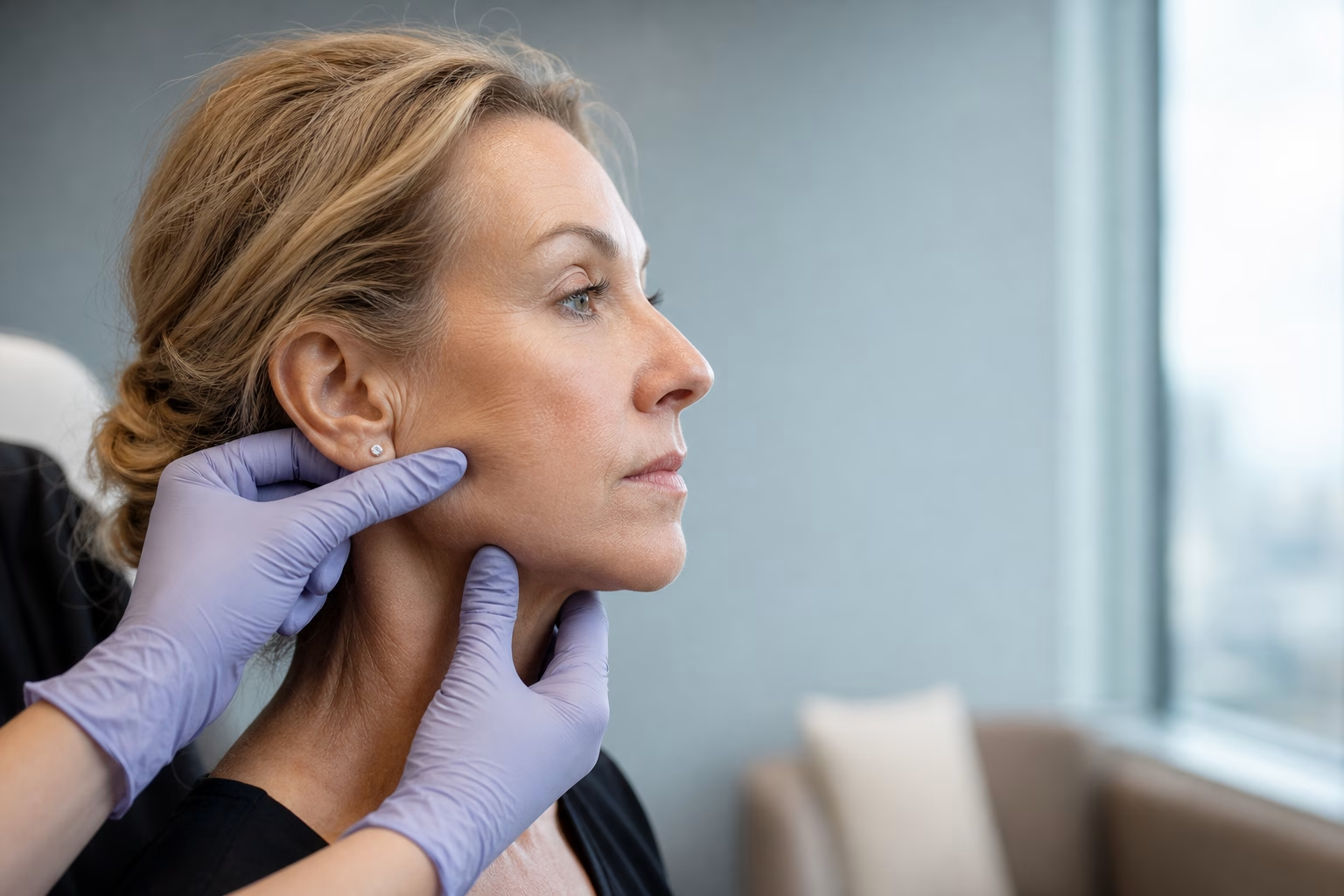
Endolift aftercare mostly means protecting the tiny entry points, keeping skincare gentle, avoiding sun exposure and following your provider’s written instructions while mild swelling settles. After this minimally invasive 1470 nm laser treatment, AestheteMed’s materials describe mild swelling, redness and possible minor bruising at the entry points. The clinic’s guide says most people return to work and social activities within about 1 to 3 days, while the lifting effect keeps developing for 3 to 6 months as new collagen forms.
This guide goes phase by phase: what tends to be normal, what helps, what to clear with your provider first, and which symptoms are worth a call. Where published clinic information stops, we say so and point you to your provider instead of guessing. It is general information, not medical advice for your specific treatment.
If you are still deciding whether Endolift is right for you, start with our guide to how Endolift works and who is a good candidate.
Endolift Recovery at a Glance: What to Expect
During Endolift, hair-thin optical fibers (about 600 microns in diameter, according to the clinic’s Endolift guide) are placed through tiny entry points into the hypodermis, the tissue layer beneath the dermis. The clinic explains that the 1470 nm laser energy is absorbed by water and fat, contracting connective tissue and breaking down localized fat. No scalpel is used, so recovery centers on the entry points and the treated tissue underneath.
| Recovery factor |
What clinic sources describe |
| Treatment time |
About 30 to 60 minutes; about 45 to 60 minutes for full face |
| Numbing |
Local anesthesia on the service pages; topical numbing cream applied 30 to 45 minutes beforehand in the clinic guide. Your provider decides which applies to you. |
| Common short-term effects |
Mild swelling, redness, possible minor bruising at entry points |
| Downtime |
Minimal on the general Endolift page; 1 to 3 days on the full face page and in the clinic guide |
| Results |
Some tightening visible right away; peak results at around 3 to 6 months |
| Sessions |
Usually one |
Why do the downtime estimates differ? The Endolift treatment overview calls downtime minimal, says most patients can return to their daily routine right away, and notes that swelling or redness typically subsides within a few days. The full face Endolift page lists 1 to 3 days, and the clinic guide gives the same range for returning to work. Treating one small area is not the same as treating the whole face. If several zones are treated or you have an event coming up, plan around the 1 to 3 day estimate and confirm it with your provider.
Endolift Recovery Timeline, Day by Day
Most visible recovery happens in the first week, while results build over the following 3 to 6 months. The phases below follow the timeline in AestheteMed’s materials. Your own course may be faster or slower.
Treatment Day
Most people feel warmth or pressure during the procedure rather than sharp pain. The clinic describes an immediate contraction of the skin, so you may notice some tightening the same day. You may also see tiny marks where the fibers entered, and the area may feel numb while the anesthetic wears off.
The First 24 to 72 Hours
This is when mild swelling, redness and minor bruising at the entry points are most likely. According to the clinic guide, most patients return to work and social plans within 1 to 3 days. Clinic sources do not say exactly when swelling peaks, so ask your provider how much buffer to leave before an important event.
Days 4 to 7
The clinic timeline describes initial swelling subsiding during the first week, and some people already notice firmer skin. The entry points are described as healing quickly. Avoid judging your final result now: the main lifting effect has not developed yet.
Weeks 2 to 6
The clinic describes weeks 2 to 4 as a period of progressive improvement in skin tightness and contour definition, with visible lifting continuing through months 1 to 3. How long subtle swelling or firmness under the skin lasts in this window differs from person to person. If something feels different from what you were told to expect, raise it at your follow-up.
Months 3 to 6
Peak results typically appear between months 3 and 6, as collagen remodeling matures. The skin should feel firmer and the contour more defined than in the first weeks. How long results last varies from person to person.
Does Recovery Differ for Face and Body Areas?
Endolift can treat the lower face, neck, under-eyes, abdomen, arms, inner thighs and knees. Recovery can vary by area: larger body zones and multi-area sessions may need more time, so ask your provider for an estimate specific to your treatment plan.
Swelling, Bruising, Numbness and Tightness: What Is Normal
Mild swelling, redness and small bruises at the entry points are the expected short-term effects in clinic materials, and all of them should gradually improve. A 2024 systematic review of 23 studies on the intralesional 1470 nm diode laser (Aesthetic Plastic Surgery) likewise found that reported side effects were mild and self-limiting, while noting that larger controlled studies are still needed. A symptom that worsens, spreads or lingers well beyond what your provider described is the signal to check in.
How Long Does Swelling Last After Endolift?
Clinic sources describe mild swelling that typically subsides within a few days and eases over the first week. How long it lasts depends on the treated area and how much tissue was treated, so ask your provider what is typical for your plan.
Bruising at the Entry Points
Minor bruising may appear where the fibers entered. The clinic’s pre-treatment guidance notes that you may be advised to avoid certain medications (NSAIDs, blood thinners) and alcohol in the days before treatment. Make these changes only on your doctor’s advice, and never stop a prescribed blood thinner on your own.
Numbness and Tightness
Numbness from the anesthetic should fade as it wears off. A tight feeling is part of the intended effect: according to the clinic, the laser heat contracts collagen fibers, which produces the early lift. If numbness persists, tell your provider rather than waiting it out.
| Usually expected |
Check with your provider |
| Mild swelling that eases over several days |
Swelling that increases after the first few days |
| Redness around the treated area |
Redness that spreads, feels hot or comes with fever |
| Small bruises at entry points |
Large, expanding or very painful bruising |
| Temporary numbness while the anesthetic wears off |
Numbness or weakness that does not fade |
| A firm, tight feeling |
Hard, painful lumps or skin changes such as blisters |
Does Endolift Hurt? Comfort During and After Treatment
Most people find Endolift tolerable because the area is numbed before the fibers are placed, and the clinic guide says patients typically describe mild warmth or pressure during treatment. Clinic materials mention either local anesthesia or a topical cream applied 30 to 45 minutes beforehand; your provider chooses the approach.
Afterward, expect tightness and some tenderness where there is swelling or bruising, rather than sharp pain. Ask which pain reliever is appropriate before taking one. NSAIDs are among the medications the clinic’s pre-treatment guidance flags, so the same question applies to the days after treatment.
Endolift Aftercare: Do’s and Don’ts
The list below is general guidance drawn from AestheteMed’s published materials. It is not an official clinic protocol, and your provider may add to it or adjust it.
Do
- Follow the written aftercare instructions you receive at your appointment.
- Use gentle skincare on the treated area, as the clinic guide recommends.
- Avoid sun exposure, which the clinic guide lists as part of aftercare. In South Florida, plan shade and coverage for errands and commutes, not only beach days.
- Ask about arnica. The clinic guide mentions arnica supplements as a possible part of aftercare, but evidence on how well it reduces bruising is limited. Take it only if your provider recommends it.
- Leave the entry points alone: no picking, scratching or rubbing while they heal.
- Keep your follow-up appointments so your provider can check your progress.
Ask Your Provider Before You
- Return to intense workouts or heat exposure such as saunas or hot yoga
- Drink alcohol in the first days after treatment
- Start new medications or supplements, including pain relievers
- Book facials, massages or other energy-based treatments on the treated area
- Wear makeup or use active ingredients such as retinoids or acids on the area
- Use compression garments or change your sleep position, especially after neck or body treatment
Clinic sources do not set fixed timelines for these activities. Ask about each one before treatment so you can plan your first week around the answers.
Warning Signs: When to Contact Your Provider
A normal Endolift recovery gets steadily better. Contact your treating clinic promptly if a symptom gets worse instead of better, or if something appears that you were not told to expect, for example:
- Swelling or pain that increases after the first two to three days
- Redness that spreads, warmth, drainage from an entry point, or fever
- Blisters, open areas or unusual skin discoloration over the treated zone
- Hard, very painful or rapidly growing swelling
- Numbness, altered sensation or facial weakness that does not fade
Trouble breathing or swallowing, particularly after neck treatment, is an emergency: call 911. For everything else, contact the clinic that treated you through its website or usual booking channels and describe what you are seeing. Photos taken in good light can help your provider assess the area.
How AestheteMed Can Help With Your Endolift Plan and Recovery
A smooth recovery starts before treatment. At AestheteMed (2100 East Hallandale Beach Boulevard #100, Hallandale Beach, serving Miami, Aventura and Fort Lauderdale), every Endolift plan begins with a consultation. Your provider assesses your skin quality and degree of laxity, reviews your medical history and medications, and gives you personalized pre- and aftercare instructions.
To learn more, see the Endolift treatment overview or the full face Endolift details. For budgeting questions, read the Endolift cost guide. Your exact pricing is confirmed at consultation.
Frequently asked questions
Will the Endolift entry points leave marks?
The fibers enter through tiny points rather than incisions, and clinic materials describe them as healing quickly. Healing varies from person to person, so leave the points alone while they heal, protect them from the sun and show your provider anything that does not fade.
How many Endolift sessions will I need?
Clinic sources describe Endolift as usually a single-session treatment. Whether maintenance makes sense later depends on how your skin ages and is something to discuss with your provider.
How long do Endolift results last?
Results reflect tissue remodeling rather than added volume. Clinic materials describe them as long-lasting but give differing estimates, and durability varies with age, skin condition and lifestyle. Your provider can discuss realistic expectations at consultation.
Can I combine Endolift with other treatments?
The clinic guide notes that some patients pair Endolift with treatments such as Morpheus8 RF microneedling or PDO threads. Your provider decides whether combining makes sense and how to time other procedures around your recovery.
Who should not have Endolift?
According to the clinic guide, Endolift is not recommended during pregnancy or breastfeeding, for very severe skin laxity, with certain autoimmune conditions, with active skin infections, or while taking photosensitizing medications. A consultation confirms whether you are a candidate.